

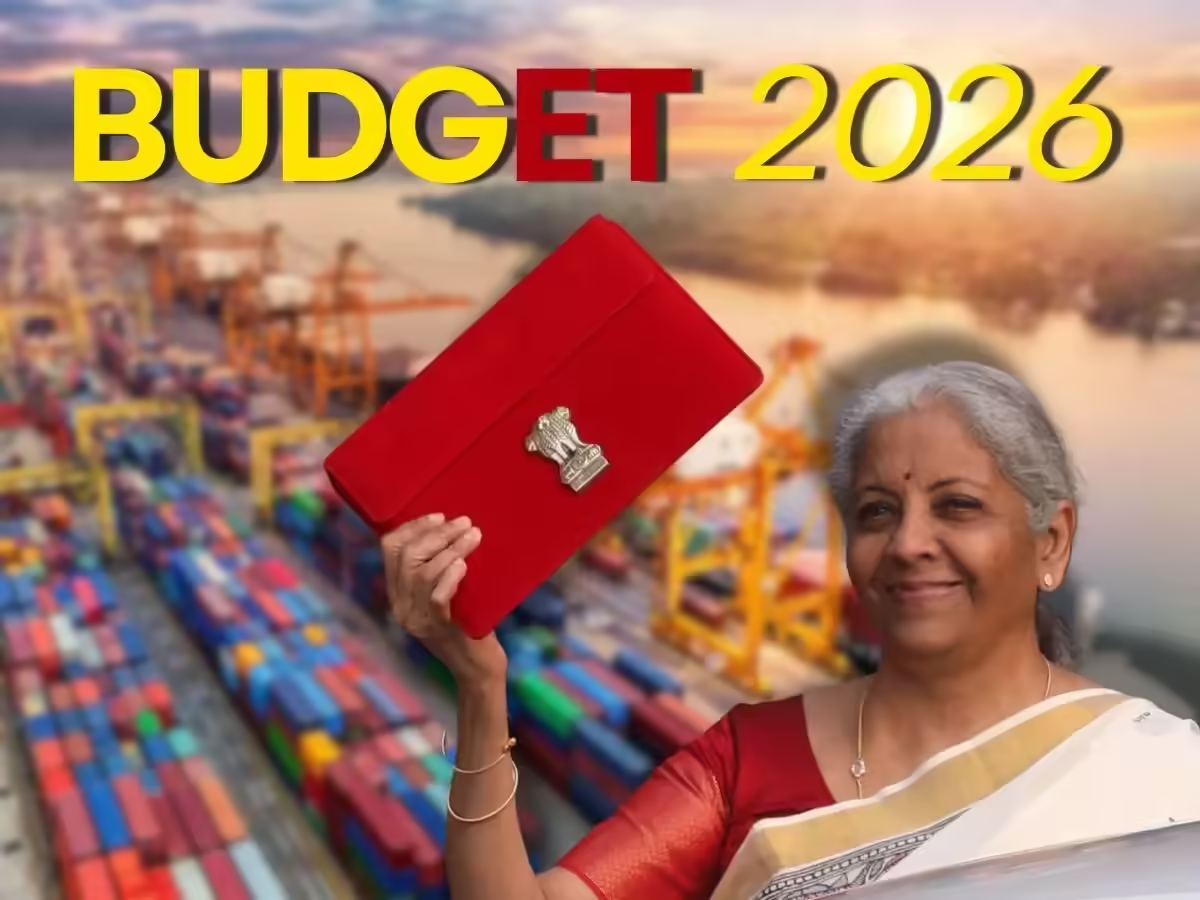
📌 Introduction: What Is the Union Budget?
The Union Budget of India, also called the Annual Financial Statement, is the government’s financial plan for a fiscal year — detailing how much revenue is expected and how that money will be allocated across various sectors. It is presented every year by the Finance Minister in Parliament under Article 112 of the Constitution of India.
🧠 For competitive exams, remember:
-
It reflects economic priorities, tax proposals, spending plans, and policy reforms.
-
It has a constitutional basis and must be approved by Parliament before implementation.
📅 Union Budget 2026 Presentation – Key Facts
📍 Date & Time
The Union Budget 2026–27 is scheduled to be presented on 1st February 2026 (Sunday) at around 11:00 AM by Finance Minister Nirmala Sitharaman — marking a rare Sunday presentation in India’s budget history.
📌 Halwa Ceremony
Before the Budget session, a traditional Halwa ceremony is held as part of final preparations in North Block — symbolizing that all officials involved have completed their budget work.
🧠 Why Do Competitive Exam Aspirants Study the Budget?
The Union Budget is an important topic for General Studies papers (especially Economics & Governance) because it reflects:
✔ Government’s economic policy direction
✔ Tax and revenue proposals
✔ Fiscal discipline and targets
✔ Priority sectors like agriculture, education, health, infrastructure
✔ Welfare and social sector outlays
This information is frequently asked in UPSC Prelims, Mains GS Paper-3, SSC CGL, RRB, Banking Exams, and State PSCs.
📊 Structure of the Union Budget
The Budget generally has two major parts:
1. Annual Financial Statement
-
Documents expected receipts (tax & non-tax revenue)
-
Shows planned expenditure
-
Includes revenue and capital budgets
2. Budget Documents
Key documents include:
-
Finance Bill – contains proposed changes in direct and indirect taxes.
-
Demand for Grants – lists allocations for ministries/departments.
-
Expenditure Budget – details government spending.
-
Receipts Budget – details revenue sources including taxes.
🔑 Pre-Budget Expectations (2026)
Before the actual Budget speech, analysts and sectors highlight major expectations which reflect key economic priorities:
🧾 Income Tax Relief & Compliance
There’s a strong demand for income tax rationalisation, simplification of TDS/TCS norms, and relief for middle-class taxpayers.
🏗 Infrastructure & Capital Expenditure
Economists and industry leaders expect sustained capital expenditure on roads, railways, logistics, and future-ready infrastructure.
📦 Support for MSMEs & Exports
With global uncertainties (like tariff pressures), there’s pressure to support MSMEs and export-oriented sectors to enhance competitiveness.
🎓 Education & Skilling
Education stakeholders seek increased funds for digital learning, skilling programs, and student-centric financing to align with employment needs.
🏡 Housing & Real Estate
Industry bodies want tax incentives such as higher home loan deductions and support for rental housing missions.
📊 Fiscal Discipline
There’s an expectation that the government will aim to maintain fiscal deficit targets (e.g., near ~4.4% of GDP).
📈 What Competitive Exams Focus On
Students must understand:
✅ Economic Terms
-
Fiscal Deficit
-
Revenue Deficit
-
Capital Expenditure
-
Revenue Expenditure
-
Tax Revenue vs Non-Tax Revenue
👉 These terms often appear in objective-type questions.
🔍 Expected Focus Areas for Budget 2026
Although detailed figures and policy changes will be clear only after the Budget is presented, the following themes are likely:
📌 1. Economic Growth & Stability
India is projected to maintain strong GDP growth (~7–7.5%) with resilient consumer demand and private investment focus.
📌 2. Taxation
-
Minor tweaks may be proposed to income tax slabs and exemptions.
-
Continued efforts may be made towards tax simplification and compliance ease.
📌 3. Infrastructure & Connectivity
Capital investment in transport, urban infrastructure, and utilities is expected to continue — crucial for long-term growth.
📌 4. Social Sector Spending
Allocations in healthcare, education, social welfare, nutrition, and rural development are key for inclusive growth.
📌 5. Technology & Innovation
Support for emerging sectors like AI, digital services, fintech, and research & development will factor into growth strategy.
📚 Budget and Competitive Exams: Strategy
✍ Study Tips
✔ Refer to official budget documents after the Budget is presented (like Finance Bill).
✔ Understand sectoral allocations and policy changes for mains answers.
✔ Revise economic concepts – deficit, GDP, revenue vs capital expenditure.
✔ Track post-budget analysis by economic experts.
✅ Conclusion
The Union Budget 2026 is a critical event that shapes India’s economic direction for the coming year. For competitive exams, it provides rich content in areas of taxation, public finance, governance, economic planning, and policy priorities.



Leave a Reply